Short answer: set up both, lead with Alipay
Both apps let foreigners link a Visa, Mastercard, or JCB card without a Chinese bank account. Alipay’s Tour Card onboarding is reported as the smoother of the two, and it covers restaurants, transit, Didi, and most street-level QR payments. WeChat Pay is the essential backup: some merchants and city services only take it, and some domestic mini-program bookings work only through WeChat. Set both up before you fly — do the card linking and identity verification from home, not on arrival.
Set up Alipay step-by-step →Alipay vs WeChat Pay: side-by-side comparison
| Feature | Alipay | WeChat Pay |
|---|---|---|
| Foreign-card onboarding | Tour Card mini-program. Visa/Mastercard is the primary path; JCB, Discover, and Diners Club are also supported. American Express is officially supported — an Amex-Alipay linkage was announced in February 2025 — but 2026 traveler reports on actual linking remain mixed, so carry a Visa or Mastercard as backup. | International Card in Wallet. Supports Visa, Mastercard, and JCB. WeChat’s help pages also list American Express among linkable networks, but 2026 traveler reports on actual linking remain mixed — carry a Visa or Mastercard as backup. |
| Foreign-card transaction fee | No fee on transactions of ¥200 or less; above that, a 3% service fee applies to the full transaction amount (per english.beijing.gov.cn and Shanghai municipal English portals, checked 2026-07-04). | Same fee structure reported — free at or under ¥200, 3% on the full amount above that (same municipal sources, checked 2026-07-04). |
| Where it typically fails | Personal transfer QR codes (the private codes some stall owners use, as opposed to printed merchant codes), domestic-only mini-programs and city services, and prepaid or virtual cards often fail KYC. | Same domestic-only mini-program limits apply. Setup is commonly reported as more complex for foreigners than Alipay’s Tour Card flow. |
| Transit / metro QR fare | Yes — a built-in city transit service in the Transport tab for many cities. | Partial — coverage varies by city. Confirm at the station before relying on it. |
| Ride-hailing (Didi) | Built in — book without leaving the app. | Built in — same booking flow. |
| Refunds | Merchant-initiated refunds typically reverse to Tour Card and credit back to your foreign card via the card network, usually within several business days. Your card’s standard chargeback process is also available as a fallback. | No equivalent verified refund-flow detail in our sources. Expect a similar merchant-initiated, card-network reversal, and confirm timing with the merchant or your card issuer. |
| English UI for travelers | Strong, traveler-focused. | Functional, less polished for travelers. |
| Our recommendation | Primary app — set up first. | Essential backup — set up in parallel. |
Recent development (verified July 2026): since May 2026, Tencent has begun linking WeChat Pay's merchant QR network to PayPal — initially for U.S. PayPal users, with other countries added in phases — letting PayPal-only travelers pay at WeChat QR merchants without linking a bank card first. Fees for PayPal-funded payments aren't yet clearly documented, so card linking remains the more predictable default.
How paying actually works — the same two motions in both apps
Whichever wallet you open first, every payment comes down to one of two motions. Learn both and you can handle any counter, menu, or posted QR code without hesitating.
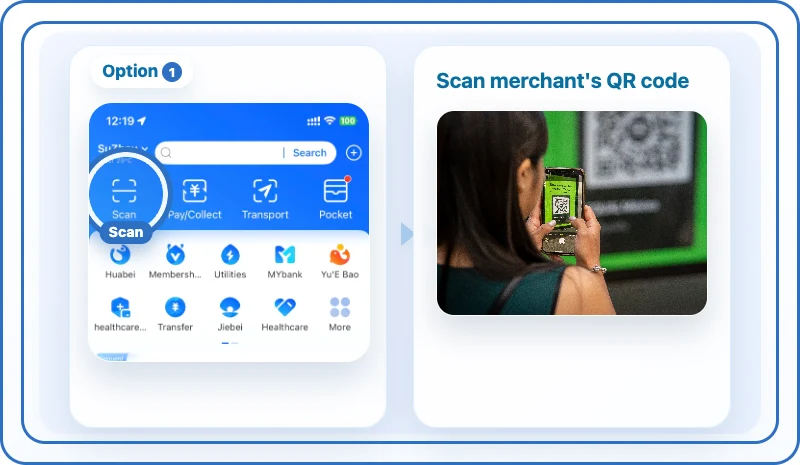
For posted QR codes — restaurants, market stalls, street vendors. Tap Scan, point at the merchant’s code, enter the amount, confirm.
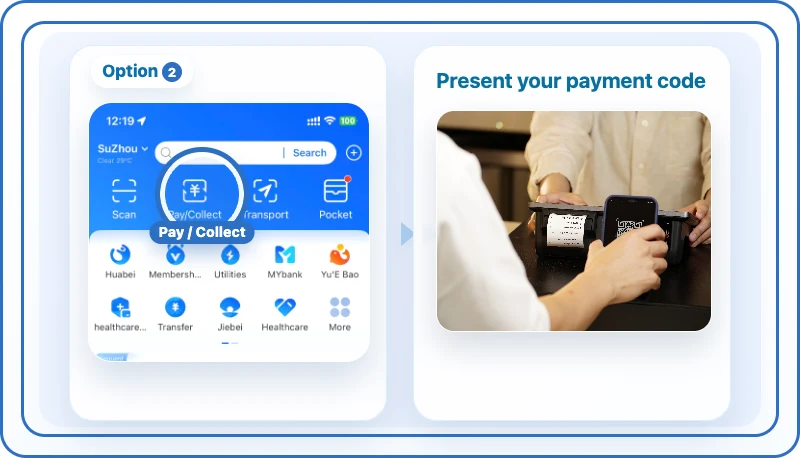
For small shops and counters. Tap Pay, show the cashier your code, they scan it — payment is instant.

Which app should you actually open, situation by situation?
Scan to pay in either app works. Alipay’s English UI is usually the smoother experience for foreign travelers.
Try Alipay Scan first. Personal transfer QR codes are one of the most commonly reported foreign-card failure points — if it fails twice, switch to WeChat Pay or cash instead of retrying the same code.
Open Alipay’s Transport tab for a timed QR. If your city isn’t covered, check WeChat Pay’s partial transit support, or buy a paper ticket as a fallback.
Either app works — book from whichever you already have open.
WeChat Pay is the only option here. This is the main reason to set it up in parallel even if you plan to lead with Alipay.
Use your physical card directly, or rely on your card’s chargeback process, rather than depending on either wallet exclusively.
Traveler reports (July 2026)
Aggregated from dated 2026 traveler posts and forum threads — traveler reports, not official information. These don’t override the verified facts above.
Relayed reports from May 2026 describe direct Visa/Mastercard binding as covering nearly all everyday city spending, with quick English-language setup — failures cluster around rural vendors and cash-only stalls.
Travelers continue to report personal transfer QR codes failing with a linked foreign card. A workaround relayed in 2026 reports: have a local contact top up your wallet balance by transfer, then pay from that balance instead.
One traveler report from November 2025 describes Alipay’s own daily spending limit blocking payments mid-trip with no clear error message, resolved only after raising the limit in Settings. A single report, not a confirmed pattern — worth checking your limit before you fly regardless.
Common mistakes travelers make choosing between the two
American Express is officially supported on both apps (a Feb 2025 Alipay+/Amex linkage, plus WeChat’s own linkable-network listing), but 2026 traveler reports on actual linking remain mixed, and prepaid or virtual cards commonly fail KYC on either app. Test both wallets with a physical Visa or Mastercard before you fly.
A personal transfer QR failure is usually a category the wallet won’t clear, not a fixable retry. Switch payment method — the other wallet, your card directly, or cash.
Some domestic mini-program bookings and city services only work through WeChat. Travelers who set up only Alipay can get stuck at exactly those counters.
Complete Tour Card / International Card KYC and one small test payment from home for both apps — troubleshooting a card issue is far easier on your home network than mid-trip. Travel guides through 2026 report stricter foreign-card verification since late 2025 — binding reviews reportedly can take a day or more, and repeated failed attempts may temporarily lock the account — finish setup well before flying.
FAQ
Frequently asked questions
Continue your China prep
Download, verify your passport, link your card, and run a test payment — five steps before you fly.
Alipay, WeChat Pay, cash, and foreign cards explained together.
Both Alipay and WeChat Pay need a live mobile-data connection — line up a foreign eSIM before you fly.
Everything to prep before you fly, in one list.
How we compared these two apps
- Every claim on this page is re-packaged from the verified facts on our Alipay for foreigners guide and payment guide — we did not introduce new claims about either app for this comparison.
- We deliberately avoid publishing specific yuan limit numbers: Alipay has revised its tourist spending limits multiple times since 2023, and the current values are shown inside the Tour Card mini-program, not on any fixed page.
- Where we don’t have verified data for WeChat Pay (for example, exact Amex support or refund-flow detail), we say so explicitly rather than assuming parity with Alipay.
Sources
- Alipay International — foreign card setup for travelers— Ant Group· Reviewed 2026-06-25
- Guide to Payment Services in China— Embassy of the People's Republic of China in the UK· Reviewed 2026-06-26
- WeChat Pay — foreign card support— Tencent· Reviewed 2026-08-26
- WeChat Pay Exempts 3% Transaction Fees for International Card Purchases Under CNY 200— Beijing Municipal People's Government (english.beijing.gov.cn)· Reviewed 2026-07-10
Last updated: