Short answer: Yes — through the Didi mini-program inside Alipay
Most tourists never need a Chinese phone number for Didi. The Didi mini-program built into Alipay uses the Alipay account you registered with your home-country number, and pays through the foreign card you already linked — no separate Didi account, download, or Chinese SIM. The standalone Didi app is also reported to accept international numbers at sign-up, but that support is version-dependent — check the current app rather than counting on it. Your no-phone-number-at-all fallback is the official metered taxi queue with your destination shown in Chinese characters.
What you need before your first Didi ride
The Alipay route only works if Alipay itself is set up — and that is a do-at-home job, not an in-the-taxi-line job. Full instructions are in our Alipay for foreigners guide; the checklist version:
- Alipay installed and registered with your home phone number — choose the tourist / international path, not a mainland China account.
- Passport identity verification (KYC) completed — unverified accounts can hit limits at the worst moment.
- A foreign card linked via the Tour Card mini-program — Visa or Mastercard is the safest starting point; run a small test payment at home.
- Mobile data that works in China — an eSIM activated before landing. Didi cannot book, track, or message without a live connection.
- Your hotel address saved in Chinese characters — as a screenshot, for when address search or the driver needs it.
Four ways to get a ride — compared
| Route | Chinese number needed? | Setup | Notes |
|---|---|---|---|
| Didi mini-program in Alipay (recommended) | No — home number via Alipay | Alipay + Tour Card (do at home) | The path this guide recommends: reuses the Alipay account and foreign card most travelers already set up for payments. |
| Didi mini-program in WeChat | No — reported: home number via WeChat, same as Alipay | WeChat Pay International + foreign card (do at home) | Didi is also built into WeChat as a mini-program, the same way it is built into Alipay — useful if WeChat Pay is already your backup payment method. Less documented in third-party travel guides than the Alipay route, so verify the current flow before relying on it. |
| Standalone Didi app | Reported: no, for many countries | Separate Didi sign-up with SMS code | International-number support is version-dependent and SMS codes can be slow to arrive while roaming — verify in the current app before relying on it. |
| Official metered taxi | No — no phone needed at all | None | The universal fallback. Staffed queues at airports and stations; show your destination in Chinese characters and confirm the meter. |
Booking a Didi through Alipay, step by step
The four moments you will actually see on screen, at a glance — full detail for each is in the numbered steps below.
Illustrative recreation — not actual app screenshots.
Open Alipay and find "DiDi Travel"
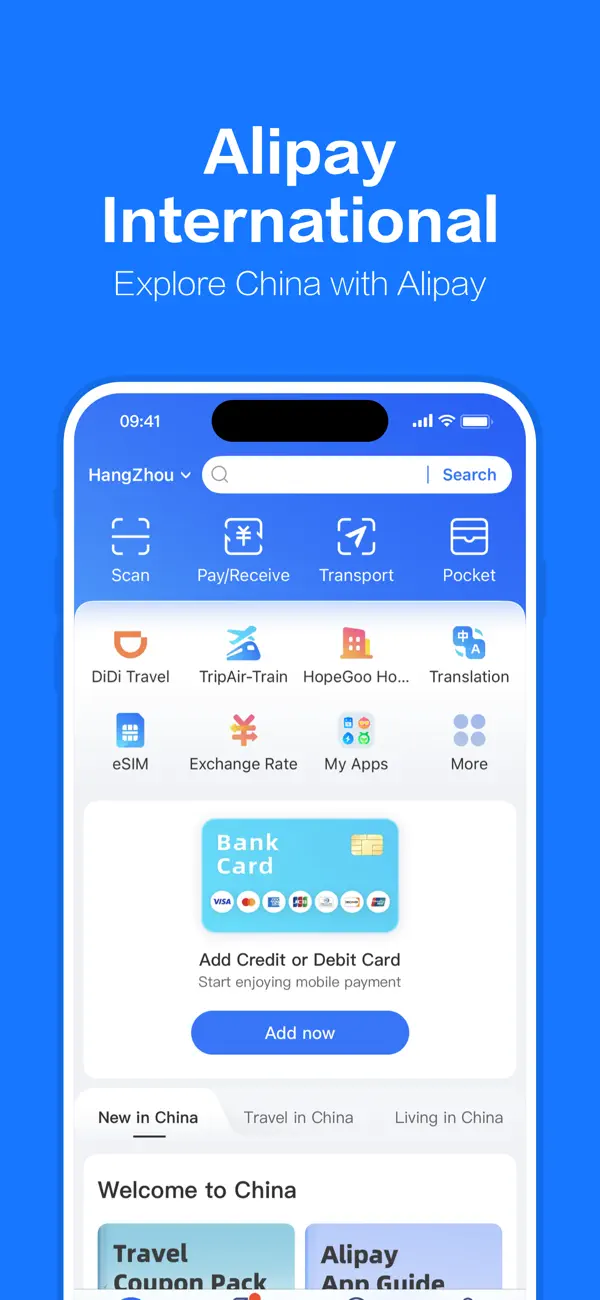 Alipay home screen — DiDi Travel sits right in the mini-program grid.
Look for the transport / car icon on the Alipay home screen — Didi opens as a built-in mini-program right in the app grid, no download and no new account.
Set your destination before moving
Type the address — a Chinese-language address is more reliable than an English hotel name — or drop a pin on the map when search comes up empty. Travelers report that pasting the Chinese-language address straight from Amap or your booking confirmation avoids the destination mismatches that English hotel names can cause.
Check the fare estimate and confirm
The app quotes a fare before you commit; treat the in-app quote as the price, not any number from a blog.
Match the license plate before boarding
The app shows the car model, color, and plate — board only the car whose plate matches.
Message the driver in-app if needed
The app provides rider–driver messaging, and third-party guides describe built-in message translation. Travelers report that drivers commonly verify you by the last four digits of your registered phone number, and that drivers — especially in Beijing — may call rather than message; if you would rather stick to text, travelers note the translated in-app chat has a "don't call me" option. Keep messages short and concrete ("Gate 7", "north exit"), and have your pickup point in Chinese characters ready as backup.
Payment settles automatically through Alipay
At the end of the ride — the linked foreign card or your Alipay balance. No cash or card handoff in the car.
Travelers report (July 2026)
What recent travelers say actually happened — collected from dated first-person reports, not official information. App behavior changes; treat these as field notes, not guarantees.
The Didi mini-program inside Alipay is consistently reported working with a foreign phone number and no Chinese SIM — it inherits your Alipay registration, with no separate Didi signup. Several travelers also note one person can book and pay for the whole group's ride from a single account.
Standalone Didi app reports are mixed: some travelers linked a foreign Visa and used the English UI without issues, while others believed it required a Chinese SIM. One traveler's same-moment price test found the standalone app roughly 5–10% pricier than the Alipay mini-program for identical rides — a single test, not a verified pattern.
Drivers verify riders by the last four digits of the registered (foreign) phone number, and Beijing drivers often call after accepting. Travelers who could not take the call used the auto-translated in-app chat, which has a dedicated "I don't speak Chinese, don't call" option.
English hotel addresses copied from non-Chinese booking sites can mismatch Didi's search badly — one rider was nearly sent miles away. The fix travelers agreed on: paste the Chinese-language address from Amap or your booking confirmation instead.
Alipay's own foreign-card daily spending limit silently blocked payments mid-trip (a roughly ¥1,500/day case) until the traveler raised it in Alipay settings — worth checking if a Didi fare suddenly fails with no obvious reason.
Airport pickup pitfalls
Airports are where first-time Didi users most often get stuck. Ride-hailing pickup zones (网约车) are usually separate from the taxi queue — often a specific floor of a parking structure, and the zone can differ by vehicle type. The reliable sequence: book first, then let the app tell you exactly which floor and zone to walk to, then match that against the 网约车 signs. Walking to a "logical" curb before booking is how travelers end up in the wrong place with a driver they cannot find.
During peak arrival hours, the official taxi queue can also simply be faster than waiting for a ride-hailing driver to loop into the pickup structure. Terminal-specific guidance is in our Shanghai Pudong (PVG) and Beijing Capital (PEK) airport-to-city guides.
Reality check — when this route fails
The Alipay route works for most tourists, but not in every situation. Commonly reported failure points: your linked foreign card gets declined by your own bank's fraud controls (fix it in your bank app, not in Alipay); no drivers are available late at night or outside city centers; or your data connection drops exactly when you need to book.
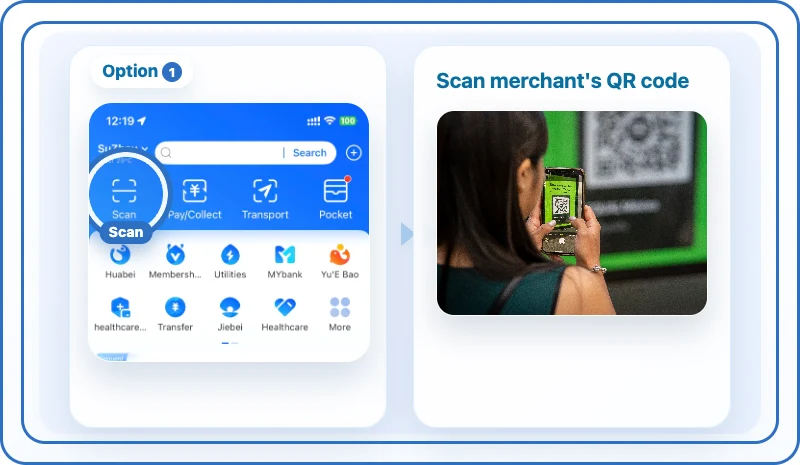
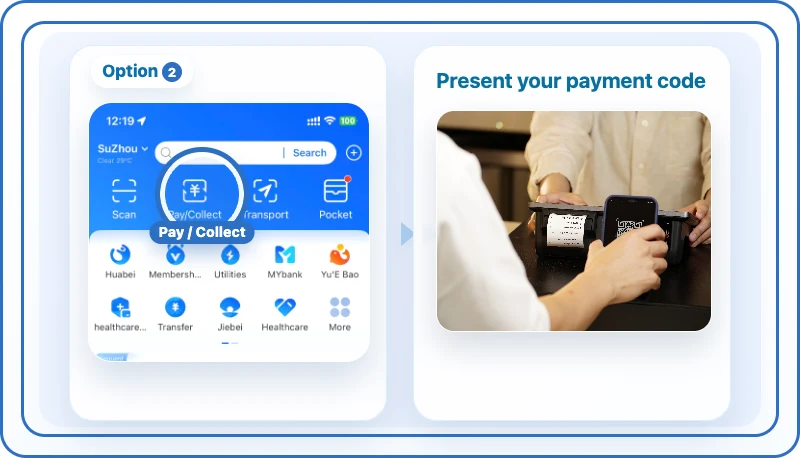
Plan for failure once per trip: keep ¥100–200 in cash for the taxi ride that Didi cannot cover, and keep your hotel address in Chinese characters saved offline. A metered taxi also takes Alipay directly — the same account you already set up for Didi:
Common mistakes travelers make
Passport KYC and card linking involve SMS codes and bank verification that are slow or flaky on arrival Wi-Fi. Finish the whole Alipay setup — including a small test payment — on your home network.
Sign-up SMS to a foreign number can be delayed or never arrive while roaming in China. If you want the standalone app, register and verify it before you fly — or just use the Alipay route, which skips Didi sign-up entirely.
At airports, the pickup zone is assigned when you book — it may be a different floor from where you are standing. Book first, walk second.
Address search handles Chinese names far better. Keep the Chinese-character address from your booking confirmation as a screenshot and paste or show it.
One dead battery or eSIM hiccup should not strand you. Cash plus a Chinese-character address turns any metered taxi into your backup plan.
How we compare providers
- We list eSIM providers that publicly advertise a China-mainland plan and either route through international gateways or document VPN-like behavior.
- Prices, data caps and validity copy come from the provider's own product page. We mark every record with a "last checked" date and re-verify before each report cycle.
- We never claim that a provider definitely bypasses China's firewall. We describe what the provider documents and what travelers consistently report. Travelers should still install a backup VPN before leaving home.
- Affiliate status is disclosed on every commercial link. We do not change provider ordering for higher commission. Provider ranking is based on price, transparency, hotspot support and traveler feedback.
Sources
- Alipay International — foreign card setup for travelers— Ant Group· Reviewed 2026-06-25
- Guide to Payment Services in China— Embassy of the People's Republic of China in the UK· Reviewed 2026-06-26
- WeChat Pay — foreign card support— Tencent· Reviewed 2026-08-26
- WeChat Pay Exempts 3% Transaction Fees for International Card Purchases Under CNY 200— Beijing Municipal People's Government (english.beijing.gov.cn)· Reviewed 2026-07-10
Last checked:
FAQ