Short answer: rarely directly — but yes, inside the wallet apps
China runs on QR payments, not card terminals — street stalls, taxis, metro gates, and restaurants often expect Alipay or WeChat Pay. Since 2023, foreigners can link a Visa, Mastercard, or JCB card inside Alipay via the Tour Card mini-program (and inside WeChat Pay via International Card), with no Chinese bank account required. That is how your foreign card actually works in China: through the wallet, paying by QR. Direct card acceptance survives mainly at international hotels, airports, and some large stores, and a foreign Visa or Mastercard withdraws cash at major bank ATMs like ICBC and Bank of China.
Set up Alipay step-by-step →Which card networks work in the wallet apps?
Support tiers below are for linking your card inside Alipay’s Tour Card — the primary foreign-card path. Always complete setup from home and run a small test payment before you fly.
| Card network | Wallet linking | What to know |
|---|---|---|
| Visa / Mastercard | Supported | Primary path via Alipay’s Tour Card and WeChat Pay’s International Card. Many issuers from the US, UK, EU, Canada, and Australia work, but bank risk controls vary — notify your bank of international travel. |
| JCB | Supported | Supported via Tour Card. Issuer verification can still fail, so complete setup from home and keep a Visa or Mastercard backup. |
| Discover / Diners Club | Supported | Listed in official documentation. Verify current status inside the Tour Card mini-program before travel. |
| American Express | Officially supported, mixed reports | An Amex-Alipay linkage was announced in February 2025, and WeChat’s help pages list Amex among linkable networks — but 2026 traveler reports on actual linking remain mixed, with some travelers linking it successfully and others hitting errors. Bring a Visa or Mastercard as backup. |
| Prepaid / virtual cards | Often fails | May fail KYC or issuer verification. Use a physical credit or debit card for the most reliable linking. |
| All networks — transaction fee | Free ≤¥200, 3% above | No fee on transactions of ¥200 or less; above that, a 3% service fee applies to the full transaction amount (per english.beijing.gov.cn and Shanghai municipal English portals, checked 2026-07-04). |
Your card lives inside the wallet, not at the register
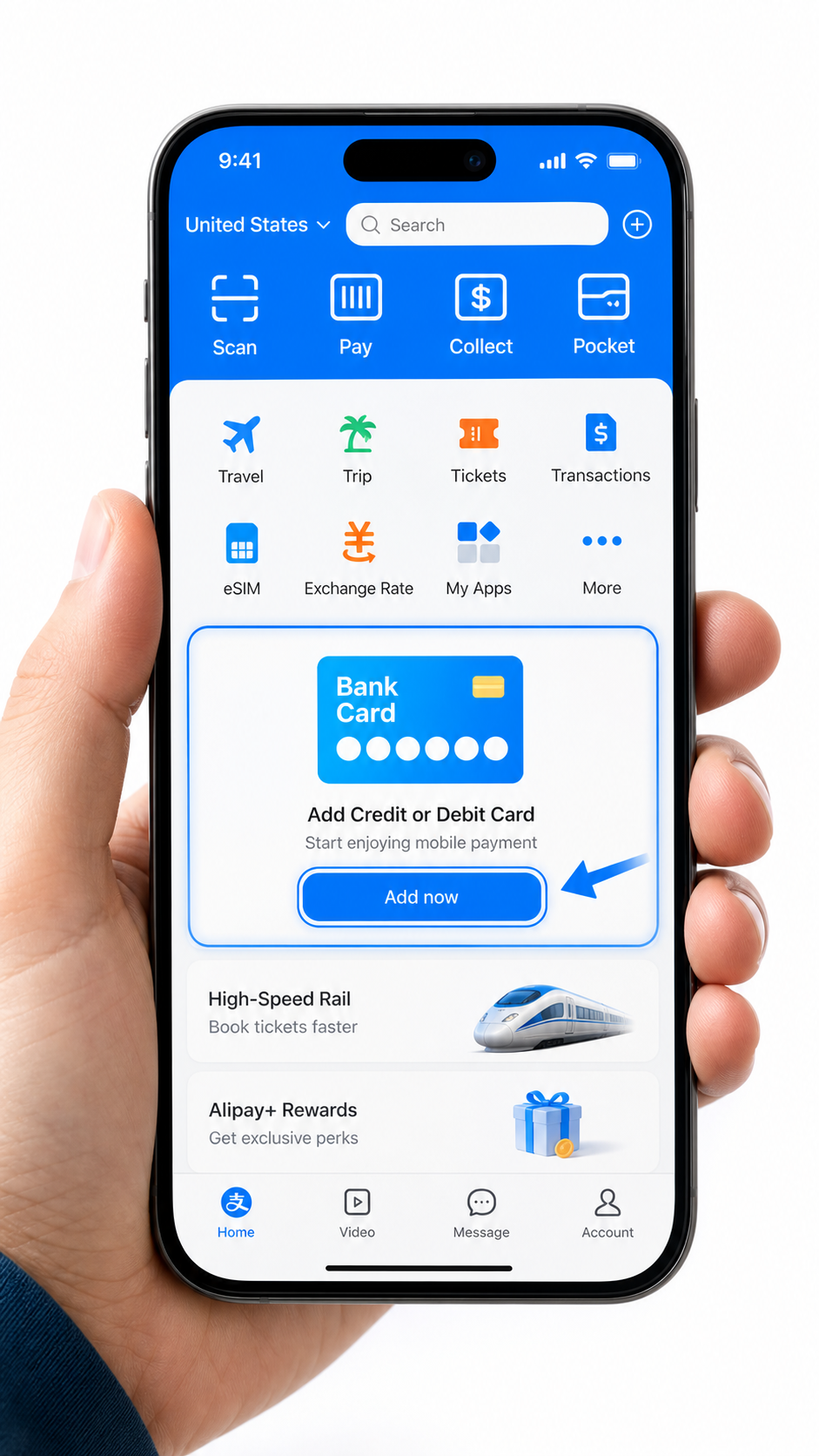
This is the Tour Card linking screen inside Alipay, where a Visa, Mastercard, or JCB card is entered once and verified. After that, your physical card stays in your bag — every payment routes through the QR code in the app, not a card swipe.
See the full setup walkthrough →Where direct card payment does work (the exceptions)
Direct card acceptance at the front desk is commonly reported at international and higher-end hotels in major cities. Smaller domestic hotels may be QR-or-cash only — don’t assume.
Duty-free shops and some airport retailers are commonly reported to take foreign cards directly. Coverage is partial, not universal — a working wallet app is still the safer plan for arrival day.
Some flagship stores in tourist-heavy areas accept foreign cards at the register. This thins out fast outside major shopping districts.
A foreign Visa or Mastercard works for cash withdrawal at ATMs of major banks such as ICBC and Bank of China. This is the standard cash backup for travelers.
Direct acceptance above is based on commonly reported traveler experience, not a guarantee — coverage varies by city and merchant. Plan around the wallet apps and treat direct card payment as a bonus when it appears.

Your cash backup plan
- Use a foreign Visa or Mastercard directly at an ICBC, Bank of China, or other large bank ATM — Alipay itself cannot withdraw cash.
- Carry a modest amount of yuan for cash-only situations: traditional markets, rural areas, and some small vendors — ideally exchanged before departure.
- Keep a physical backup card separate from your phone. If your phone breaks, a physical card for ATM withdrawals plus a small amount of cash keeps you moving.
- Check your bank’s foreign-transaction and ATM fees before you fly — your card network applies its exchange rate, and your home bank may add a fee on top.
Common mistakes travelers make with cards in China
China is QR-first: street stalls, taxis, metro gates, and restaurants often expect Alipay or WeChat Pay. A wallet-less traveler is limited to the thin slice of merchants with card terminals, plus cash.
Prepaid and virtual cards may fail KYC or issuer verification in the wallet apps. Link a physical credit or debit card for the most reliable setup.
Travelers commonly report foreign-card failures on personal transfer QR codes — the private codes some stall owners use, as opposed to printed merchant codes. If a payment fails twice, switch to the other wallet or cash instead of retrying the same code.
Identity verification and card linking are far easier on your home network. SMS codes can be slow or blocked on airport Wi-Fi in China, and issuer verification failures are hard to fix mid-trip. Travel guides through 2026 report stricter foreign-card verification since late 2025 — binding reviews reportedly can take a day or more, and repeated failed attempts may temporarily lock the account — finish setup well before flying.
A common failure mode is the card issuer silently blocking the China transaction. Tell your bank you are traveling and enable international online use before you fly — most bank apps let you do it in under a minute.
FAQ
Frequently asked questions
Continue your China prep
Download, verify your passport, link your card, and run a test payment — five steps before you fly.
Side-by-side comparison and a situation-by-situation guide.
Alipay, WeChat Pay, cash, and foreign cards explained together.
Linking a card in Alipay or WeChat Pay needs a live data connection — sort out a foreign eSIM before you fly.
Everything to prep before you fly, in one list.
How this page is sourced
- Every claim on this page is re-packaged from the verified facts on our Alipay for foreigners guide and payment guide — no new card-support claims were introduced for this page.
- Direct card acceptance at hotels, airports, and stores is described as "commonly reported" because it varies by merchant and city — we do not guarantee acceptance at any specific location.
- We deliberately avoid publishing specific yuan limit numbers: Alipay has revised its tourist spending limits multiple times since 2023, and the current values are shown inside the Tour Card mini-program, not on any fixed page.
Sources
- Alipay International — foreign card setup for travelers— Ant Group· Reviewed 2026-06-25
- Guide to Payment Services in China— Embassy of the People's Republic of China in the UK· Reviewed 2026-06-26
- WeChat Pay — foreign card support— Tencent· Reviewed 2026-08-26
- WeChat Pay Exempts 3% Transaction Fees for International Card Purchases Under CNY 200— Beijing Municipal People's Government (english.beijing.gov.cn)· Reviewed 2026-07-10
Last updated: